
Most people never think about crash tests when buying a car.They notice the design, compare features, look at the engine, and maybe check fuel economy. Safety ratings often become one small line on a long specification sheet.
But behind those ratings are years of engineering, thousands of destroyed vehicles, and lessons that quietly changed the way modern cars are built.
Now, according to new research, the impact may be far bigger than most people realize.
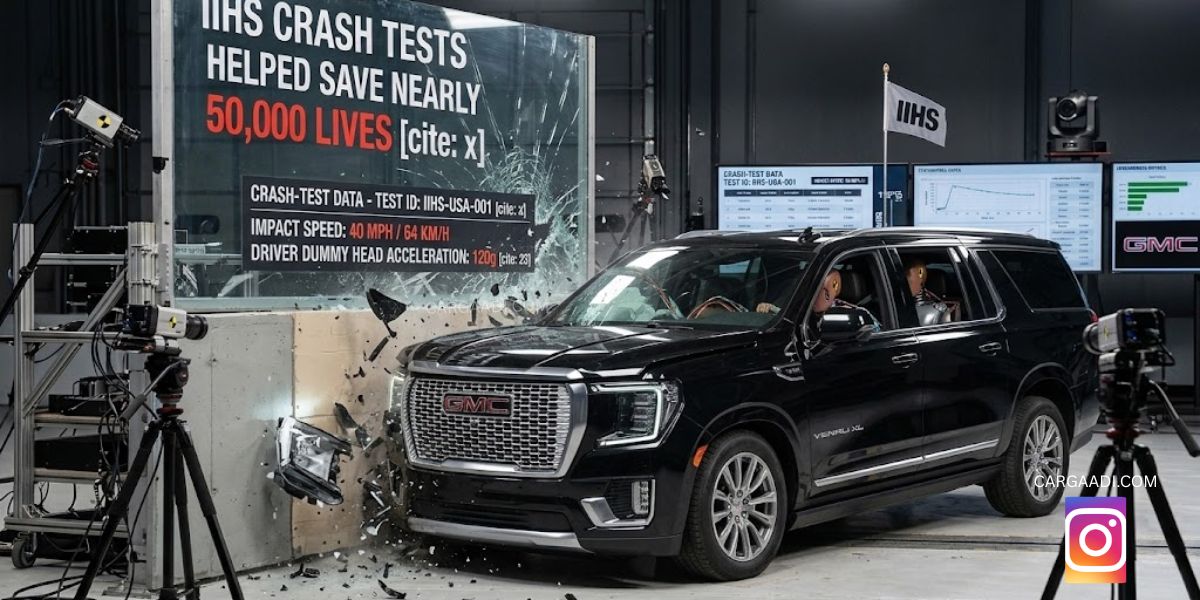
The Insurance Institute for Highway Safety (IIHS) says its crash-testing programs and safety evaluation systems have helped save nearly 50,000 lives in the United States over several decades.
That is an enormous number—and it highlights how vehicle safety improvements often become invisible because they work exactly as intended.
Crash Tests Changed More Than Ratings
Crash testing was never designed simply to create winners and losers.
The bigger goal has always been pushing manufacturers to improve.
According to IIHS research, safety programs encouraged automakers to strengthen structures, improve occupant protection, and introduce technologies that reduced injury severity during real-world crashes.
Over time, those improvements spread across the industry.
Cars that once performed poorly gradually became safer because manufacturers adapted to tougher standards.
That created benefits reaching far beyond individual models.
How IIHS Testing Influenced Vehicle Safety
| Category | Safety Impact |
|---|---|
| Frontal Crash Protection | Stronger Passenger Compartments |
| Side Impact Testing | Improved Occupant Safety |
| Roof Strength | Better Rollover Protection |
| Head Restraints | Reduced Neck Injuries |
| Small Overlap Testing | Structural Improvements |
| Advanced Ratings | Faster Safety Innovation |
| Estimated Outcome | Nearly 50,000 Lives Saved |
Figures are based on IIHS research and estimation models.
Why Crash Tests Matter More Than People Think
Automakers React When Standards Become Public
One reason crash testing became influential is visibility.
Once safety scores became public, manufacturers had strong motivation to improve results.
That created competition around protection instead of only horsepower and design.
Vehicles began receiving stronger body structures, additional airbags, improved seat systems, and more advanced crash energy management.
Many of those features eventually became normal expectations.
What once appeared only in premium vehicles slowly moved into mainstream models.
Modern Cars Are Built Differently Today
Safety Engineering Became a Core Part of Development
Modern vehicle development now includes extensive simulation, crash analysis, and real-world data.
Manufacturers often redesign structures repeatedly before production begins.
The goal is no longer simply surviving impact.
It is reducing injury risk as much as possible.
H4: Small Changes Create Huge Results
Even adjustments that drivers never see can dramatically affect outcomes.
H4: Safety Keeps Evolving
Testing standards continue becoming stricter as vehicle designs change.
The Industry Still Has Work To Do
Even with major progress, road safety challenges remain.
Vehicles continue becoming heavier and more technologically complex, while traffic environments keep changing.
Organizations such as IIHS continue updating tests to reflect modern conditions, including tougher evaluations for rear-seat protection, pedestrian safety, and advanced driver assistance technologies.
The idea is simple.
As cars evolve, safety expectations must evolve too.
Final Thoughts
Saving nearly 50,000 lives is not something drivers can easily see.
There is no dashboard warning, no celebration, and no visible reminder.
Instead, the impact appears in moments that never become headlines—people walking away from crashes that once could have ended very differently.
Crash tests may not feel exciting.
But their influence may be one of the biggest reasons modern driving looks safer today than it did decades ago.
Disclaimer
This article is based on publicly available research and statements related to IIHS crash-testing programs and estimated safety outcomes. Reported figures are statistical estimates and should not be interpreted as guarantees of individual crash outcomes.