
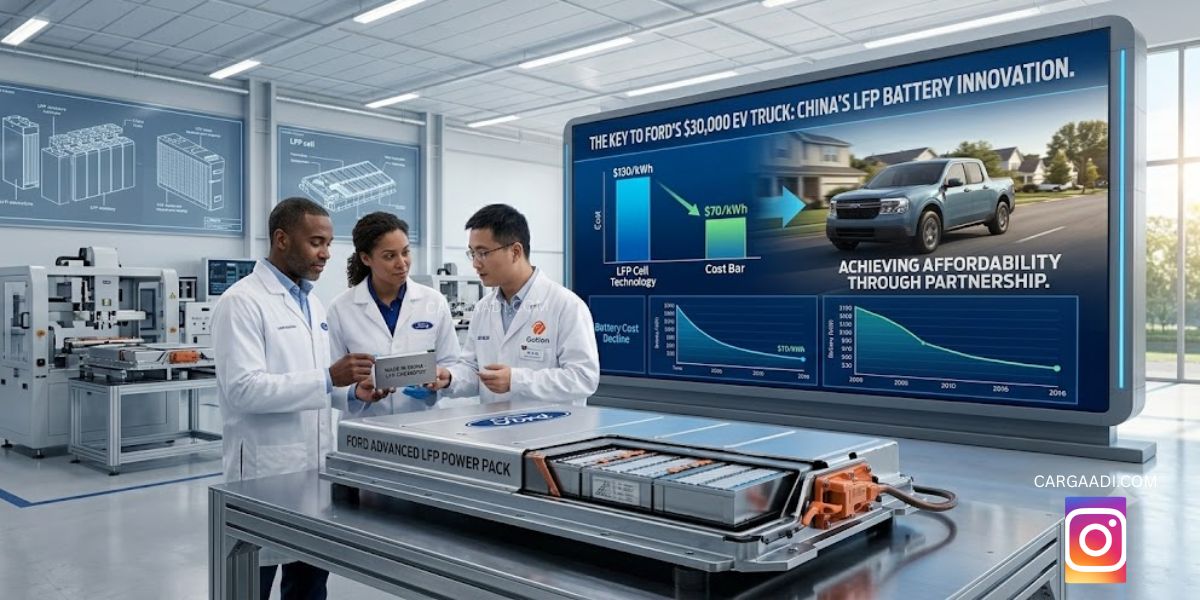
Ford wants to build an electric truck that changes the conversation.
Not a luxury EV. Not a giant battery on wheels. Not another expensive experiment.
The company’s goal is something far more difficult: a practical electric pickup expected to start at around $30,000. And surprisingly, one of the biggest reasons Ford believes it can get there comes from technology heavily associated with China’s EV revolution.
At first glance, that sounds unexpected.
But the deeper story is less about copying China and more about learning from what already works.
Ford’s Affordable EV Strategy Starts With One Big Decision
For years, many automakers tried solving EV challenges by installing larger batteries.
That approach increased range—but it also increased weight, complexity, and cost.
Ford appears to be moving in a different direction.
Its upcoming midsize electric truck will reportedly launch on the company’s new Universal EV Platform (UEV) and focus on efficiency first instead of battery size.
That shift could become one of Ford’s biggest changes in decades.
The Most Important Ingredient? LFP Battery Technology
At the center of Ford’s plan is Lithium Iron Phosphate (LFP) battery technology.
LFP batteries have become one of the strongest advantages for Chinese EV makers because they cost less to produce and are widely used in affordable electric vehicles. Ford plans to use structural LFP battery packs for its next-generation EV platform and has licensed battery technology from China’s CATL for domestic production.
This is the “China connection” attracting attention.
Instead of treating Chinese battery development as competition only, Ford appears to be borrowing proven ideas and adapting them to its own manufacturing system.
The goal is simple:
Lower cost without sacrificing usefulness.
Ford’s New Truck Is Being Designed Around Efficiency, Not Excess
Ford says affordability cannot come from one breakthrough alone.
Its future truck combines several engineering changes:
Expected Cost-Saving Technologies
- Structural LFP battery pack
- Large aluminum unicastings
- 48-volt electrical architecture
- Simplified wiring system
- Reduced parts count
- Aerodynamic optimization
- Modular production process
Ford says these changes reduce complexity and help lower manufacturing costs significantly.
Instead of making batteries larger, Ford wants every watt to go further.
Ford’s Manufacturing Strategy Looks Completely Different
The company is also redesigning how vehicles are assembled.
Reports indicate Ford’s future EV production process moves away from the traditional straight assembly line and instead builds large sections separately before combining them later.
Ford calls this approach part of its Universal EV Production System. The company says it reduces parts, shortens production time, and simplifies manufacturing.
That may sound technical—but it directly affects what customers pay.
Expected Ford $30,000 EV Truck Specifications
| Specification | Ford Affordable EV Truck (Expected) |
|---|---|
| Vehicle Type | Mid-Size Electric Pickup |
| Platform | Universal EV Platform (UEV) |
| Target Starting Price | Around $30,000 |
| Battery Type | Structural LFP |
| Electrical Architecture | 48-Volt |
| Drivetrain | RWD Expected Initially |
| Production Start | Expected 2027 |
| Manufacturing Location | Louisville, Kentucky |
Final specifications remain subject to official confirmation.
Why Ford Believes This Can Compete With China
Ford executives have openly acknowledged pressure from Chinese EV manufacturers.
Rather than trying to beat China by making bigger vehicles, Ford appears focused on lowering production costs while improving efficiency.
The company has described this project as a major reset for its EV business and one of its most important future programs.
That is important because affordable EVs have become one of the hardest segments to crack profitably.
This Truck Could Matter More Than The F-150 Lightning
Ford’s earlier EV strategy focused heavily on electrifying familiar products.
This truck appears different.
It is being built from the beginning as an EV—with cost targets, packaging, manufacturing, and battery decisions all designed around affordability.
If Ford succeeds, this truck may become less about replacing existing pickups and more about creating a new kind of electric vehicle buyer.
Conclusion
Ford’s upcoming $30,000 electric truck may wear an American badge, but one of the technologies helping make it possible has roots in China’s EV playbook.
That does not make the truck less ambitious.
If anything, it shows how global the EV race has become.
Ford’s bet is that combining American manufacturing with lessons learned from China’s battery leadership could finally make affordable electric trucks feel realistic instead of theoretical.
Disclaimer
This article is based on publicly available reports, manufacturer disclosures, and industry coverage available at the time of writing. Pricing, battery sourcing, specifications, production timelines, incentives, and final vehicle details may change before official launch.